
Image credited to Aimee Grant. Silverstone. 03/08/2025. Brooklands.
The Lotus Seven (what we now call the Caterham Seven) wasn’t born in a boardroom or conceived by numerous top engineers based in Silverstone. It began in 1956 available as a kit named the Lotus Seven. From the mind of a young structural engineer trained at the University College London and the University of London Air Squadron, Lotus was founded, ultimately winning seven Constructors’ Championships and six Drivers’ Championships in Formula One.
Colin Chapman, originally based in Surrey, graduated from UCL with a degree in structural engineering in 1949. Followed by a brief stint in the Royal Air Force, Chapman began racing in local trials and hill climbs. He developed modifications to the Austin Seven, when he raced himself. Chapman modified this design into his first creation, the Lotus Mark I, with the core idea that if you can’t increase power, decrease weight.
‘Adding power makes you faster on the straights. Subtracting weight makes you faster everywhere.’ –Colin Chapman (attributed).
Over seventy years later, Caterham Racing still uses the same philosophy, with Caterham Academy cars weighing around 550 kilograms each. Keeping Chapman’s core ideas, around 40%-50% of drivers build their own race cars that can reach speeds of up to around 116 mph and can accelerate from 0-60 mph in 5.3 seconds. By designing lightweight, front-engine vehicles, Caterhams became and remain one of the most accessible forms of motor racing.
With the original 1957 Lotus VII kits still being available today, Chapman’s ideas transcended time constraints through their accessibility.
‘Money weeds out talent,’ commented a Seven Racing driver at Silverstone. ‘Series such as GT are very expensive,’ whereas Caterham offers a more sustainable alternative of racing, with the Caterham Academy offering payment plans and second-hand cars being easily purchasable.

Image credited to Aimee Grant. Silverstone. 03/08/2025. Paddock exit.
University-level competitions such as Formula Student design and build their own cars following a similar blueprint to Caterham. Prioritising lightweight design and emphasising handling and driver engagement, Formula Student cars adopt a minimalistic approach with low budgets. With costs as low as £2,500 GBP per year, Formula Student teams aim to optimise agility and speed at the lowest possible cost.
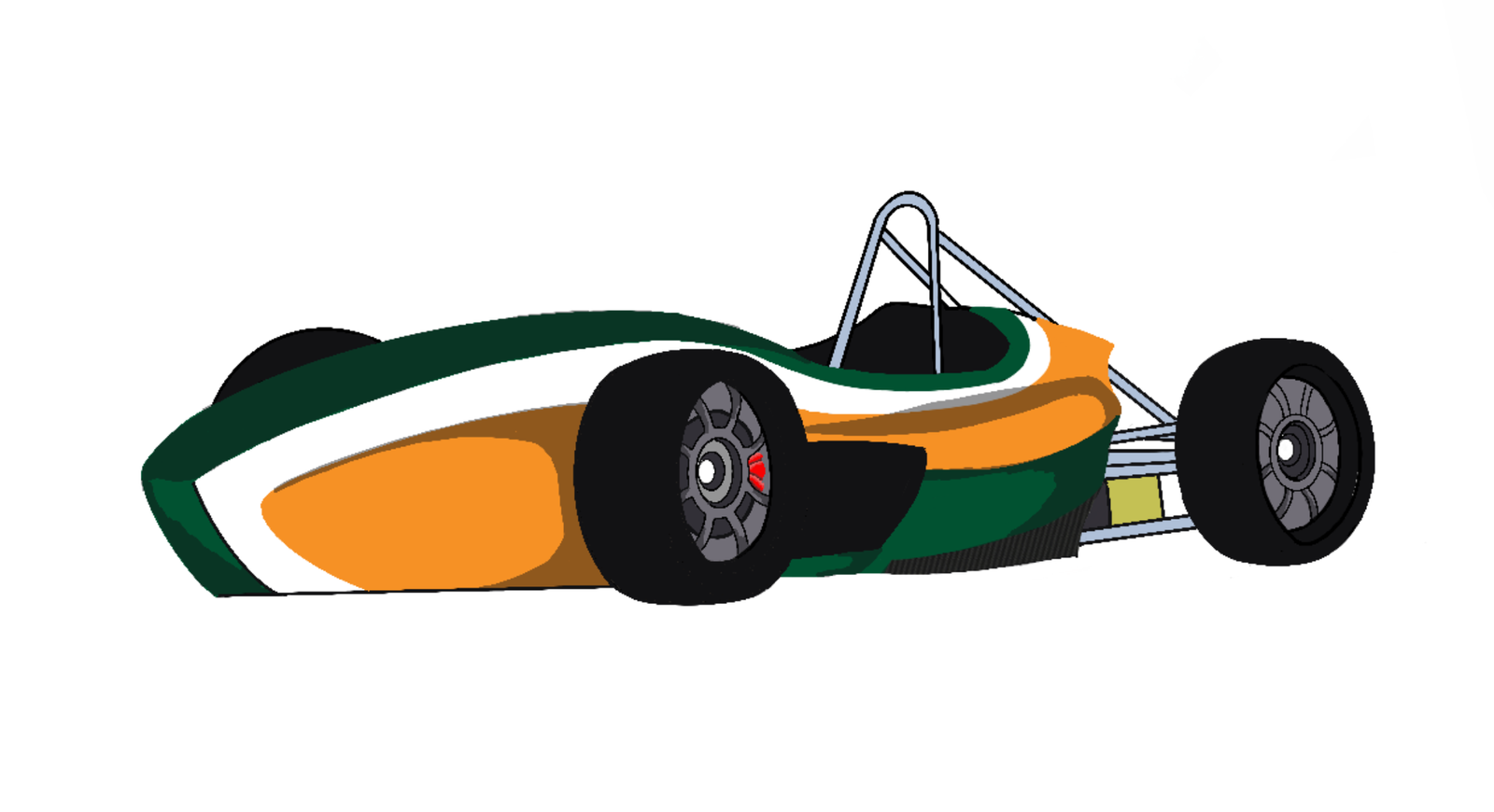
Image and design credited to Daniel Carney. Formula Student car mock up. 2024.
With such lightweight designs and modest engines, Lotus initially struggled to compete against the likes of Ferrari and Maserati during the early 1960s championships. However, with the inclusion of Jim Clark as driver, Lotus achieved victory in 1963, becoming Formula One World Champions with the Lotus 25. Also winning the 1965 Indianapolis 500, Jim Clark and Lotus became a force to be reckoned with.
Throughout his partnership with Lotus, Jim Clark won twenty-five races, achieved thirty-three pole positions and recorded twenty-eight fastest laps. The partnership between Clark and Lotus became hugely successful during this eight-year period. In 1961 Clark was involved in one of the worst accidents in Formula One history at Monza, colliding with Wolfgang von Trips and sending Von Trips car airborne, killing Von Trip and fifteen spectators. Sparking a formal investigation into the incident, Clark described the collision as ‘unavoidable.’ (In his testimony about the 1961 Monza incident, Los Angeles Times, 11/07/1961)
Colin Chapman and Jim Clark became close friends until Clark’s death in 1968 in a racing accident at the Hockenheimring in West Germany. Aged thirty-two when he died, Jim Clark held multiple Formula One records for his era.
Despite the death of one of his closest friends, Chapman continued his pioneering work in the motorsport industry, being one of the first engineers to introduce advanced aerodynamics into Formula One car design. By utilising downforce through the introduction of rear wings mounted one metre above the car, and relocating radiators from the front to sides of the vehicle, Chapman designed some of the most fundamental features of competitive race cars.

Image credited to Aimee Grant. Silverstone. 03/08/2025. Parc Ferme.
With the discontinuation of the Lotus in 1973, Graham Nearn’s Caterham Cars purchased the rights to continue manufacturing. By acquiring both the design and manufacturing expertise, Graham Nearn’s Caterham Cars could continue building the same car with the same methods. While maintaining the fundamental elements of the Lotus, Caterham has evolved through the years. Upgrading engines from 40-85hp up to 620hp, increased handling due to geometry, dampers and spring rates. Alongside improved safety features of stronger roll bars, improved seat mounting and six-point safety harnesses. Although Caterhams have been upgraded throughout the years, the DNA remains the same.

Leave a Reply